位运算 右移 >> 和 >>>
>> 是带符号右移,用符号位补位
>>> 是不带符号右移,用0补位
1 2 3 4 5 6 7 8 9 -2147483648 10000000000000000000000000000000 -1073741824 11000000000000000000000000000000 1073741824 01000000000000000000000000000000
例1:打印一个数字的32位二进制形式:
1
2
3
for (int i = 31 ; i >= 0 ; i--) { System.out.print((n & (1 << i)) == 0 ? '0' : '1' ); }
例2: Integer.MIN_VALUE,即 -2^31^,它的负数还是它自己。
二进制数的LowBit X & -X ,即 X & (~X+1) 得到 二进制数的LowBit (其二进制最低位/最右侧的1,其余位均为0):
-X的值,是在X的基础上进行按位取反之后再加1得到的,
当X为偶数时,~X为奇数,奇数加上1会发生进位,最低位的连续的1都会变为0,所以X和 ~X的低位都为0,高位都相反,只有得到进位的那个位置都为1,即X的最右边的1相等,所以,当一个偶数与它的负值相与时, 结果是能整除这个偶数的最大的2的幂, 即: m = n & -n , 则 n % m = 0, 且 m = 2^k^
当X为奇数时 ,因为奇数取反后为偶数,偶数加1并不会影响进位,所以此时 X & -X 结果一定为1 (奇数最低位的1就在二进制数的末尾)
链表 k个一组翻转链表 leetcode25.
给你链表的头节点 head ,每 k 个节点一组进行翻转,请你返回修改后的链表。
k 是一个正整数,它的值小于或等于链表的长度。如果节点总数不是 k 的整数倍,那么请将最后剩余的节点保持原有顺序。
你不能只是单纯的改变节点内部的值,而是需要实际进行节点交换。
链表中的节点数目为 n
1 <= k <= n <= 50000 <= Node.val <= 1000
例:
1
2
输入:head = [1,2,3,4,5], k = 3 输出:[3,2,1,4,5]
思路:这道题不涉及复杂的算法,但是实现过程中需要考虑的细节比较多,容易写出冗长的代码。主要考查面试者设计的能力。
1
2
3
4
5
6
7
8
9
10
11
12
13
14
15
16
17
18
19
20
21
22
23
24
25
26
27
28
29
30
31
32
33
34
35
36
37
38
39
40
public static ListNode reverseKGroup (ListNode head, int k) { ListNode start = head; ListNode end = getKGroupEnd(start, k); if (end == null ){ return head; } head = end; reverse(start, end); ListNode lastEnd = start; while (lastEnd.next != null ){ start = lastEnd.next; end = getKGroupEnd(start, k); if (end == null ){ return head; } reverse(start, end); lastEnd.next = end; lastEnd = start; } return head; } public static ListNode getKGroupEnd (ListNode start, int k) { while (--k != 0 && start != null ){ start = start.next; } return start; } public static void reverse (ListNode start, ListNode end) { end = end.next; ListNode pre = null ; ListNode cur = start; ListNode next = null ; while (cur != end){ next = cur.next; cur.next = pre; pre = cur; cur = next; } start.next = end; }
链表求和 给定两个用链表表示的整数,每个节点包含一个数位。
这些数位是反向存放的,也就是个位排在链表首部。
编写函数对这两个整数求和,并用链表形式返回结果。
1
2
输入:(7->1->6) + (5->9->2),即617 + 295 输出:2->1->9,即912
假设这些数位是正向存放的,又该如何解决呢? (翻转链表,或使用栈,将数字压入栈中,再依次取出相加)
1
2
输入:(6->1->7) + (2->9->5),即617 + 295 输出:9->1->2,即912
思路:同时遍历两个链表,逐位相加,并且加上上一位的进位,对于短的链表,可以认为其后是若干0。最后,如果遍历结束后进位不为0,还要再加一个节点。
1
2
3
4
5
6
7
8
9
10
11
12
13
14
15
16
17
18
19
20
21
public ListNode addTwoNumber (ListNode head1,ListNode head2) { ListNode head = null , tail = null ; int carry = 0 ; while (head1 != null || head2 != null ){ int n1 = head1 != null ? head1.val : 0 ; int n2 = head2 != null ? head2.val : 0 ; int sum = n1 + n2 + carry; if (head == null ){ head = tail = new ListNode (sum % 10 ); }else { tail.next = new ListNode (sum % 10 ); tail = tail.next; } carry = sum / 10 ; if (head1 != null ) head1 = head1.next; if (head2 != null ) head2 = head2.next; } if (carry > 0 ) tail.next = new ListNode (carry); return head; }
合并有序链表 合并两个有序链表 leetcode21.
将两个升序链表合并为一个新的 升序 链表并返回。新链表是通过拼接给定的两个链表的所有节点组成的。
1
2
输入:l1 = [1,2,4], l2 = [1,3,4] 输出:[1,1,2,3,4,4]
思路1:迭代,谁小就指向谁
1
2
3
4
5
6
7
8
9
10
11
12
13
14
15
16
17
18
19
public ListNode mergeTwoList (ListNode head1, ListNode head2) { ListNode ans = new ListNode (-1 ); ListNode pre = ans; while (head1 != null && head2 != null ){ if (head1.val <= head2.val){ pre.next = head1; head1 = head1.next; }else { pre.next = head2; head2 = head2.next; } pre = pre.next; } pre.next = head1 != null ? head1 : head2; return ans.next; }
思路2:递归
1
2
3
4
5
6
7
8
9
10
11
12
13
public ListNode mergeTwoLists (ListNode l1, ListNode l2) { if (l1 == null ) { return l2; } else if (l2 == null ) { return l1; } else if (l1.val < l2.val) { l1.next = mergeTwoLists(l1.next, l2); return l1; } else { l2.next = mergeTwoLists(l1, l2.next); return l2; } }
合并有序链表数组 leetcode 剑指offer II 078. 合并排序链表
树 morris遍历 morris遍历二叉树,时间复杂度O(N),**空间复杂度O(1)**。
遍历过程 设cur为当前节点,一开始cur指向树的根节点,循环执行以下流程:
如果cur无左树,cur = cur.right;
如果cur有左树,找到左树最右的节点,记为mostright;
如果mostright的右指针指向null,使mostright.right = cur,cur = cur.left;
如果mostright的右指针指向cur,mostright.right = null,cur = cur.right (由于有2.1的操作,所以mostright的右指针可能是指向cur的)
当cur为null时,流程结束。
代码 1 2 3 4 5 6 7 8 9 10 11 12 13 14 15 16 17 18 19 20 21 22 23 24 25 26 27 28 29 public static void morris (Node head) { if (head == null ) { return ; } Node cur = head; Node mostRight = null ; while (cur != null ) { mostRight = cur.left; if (mostRight != null ) { while (mostRight.right != null && mostRight.right != cur) { mostRight = mostRight.right; } if (mostRight.right == null ) { mostRight.right = cur; cur = cur.left; } else { mostRight.right = null ; cur = cur.right; } } else { cur = cur.right; } } }
前中后遍历 morris特点:有左树的节点会遍历两次,其他节点均只遍历一次。即符合2.1情况的节点是第一个遍历,符合2.2情况的节点是第二次遍历。
比如,递归遍历二叉树会经过节点三次,在不同的经过时机进行打印,就是前序、中序、后序遍历二叉树。
1 2 3 4 5 6 7 8 9 10 11 void inorder (Node *node) { if (node == NULL){ return ; } inorder(node->left); inorder(node->right); }
而morris的遍历时机:
前序遍历:在第一次遍历节点时打印
中序遍历:对于会遍历两次的节点,在其第二次遍历时打印,其他的照常打印。
后序遍历:对于会遍历两次的节点,分别逆序打印其左树的右边界,最后在逆序打印整棵树的右边界(根节点的右边界)(右边界是指这个节点一直向右走下去的路径,包括它自己)
1 2 3 4 5 6 7 8 9 10 11 12 13 14 15 16 17 18 19 20 21 22 23 24 25 26 27 28 29 30 31 32 33 34 35 36 37 38 39 40 41 42 43 44 45 46 47 48 49 50 51 52 53 54 55 public static void morris (Node head) { if (head == null ) { return ; } Node cur = head; Node mostRight = null ; while (cur != null ) { mostRight = cur.left; if (mostRight != null ) { while (mostRight.right != null && mostRight.right != cur) { mostRight = mostRight.right; } if (mostRight.right == null ) { mostRight.right = cur; cur = cur.left; } else { mostRight.right = null ; cur = cur.right; } } else { cur = cur.right; } } } public static void printEdge (Node head) { Node tail = reverseEdge(head); Node cur = tail; while (cur != null ){ System.out.print(cur.val + " " ); cur = cur.right; } reverseEdge(tail); } public static Node reverseEdge (Node from) { Node pre = null ; Node next = null ; while (from != null ){ next = from.right; from.right = pre; pre = from; from = next; } return pre; }
图 数据结构 由于图本身的数据结构表达多种多样,为了不用在和图有关的算法上使用不同种数据结构去实现。所以可以考虑只使用一种兼容性好的结构,用到的时候,将题目中的数据结构转换为常用的这个结构,就不用考虑多种结构的算法实现了。
1 2 3 4 5 6 7 8 9 10 11 12 13 14 15 16 17 18 19 20 21 22 23 24 25 26 27 28 29 30 31 32 33 34 35 36 37 38 public class Node { public int value; public int in; public int out; public ArrayList<Node> nexts; public ArrayList<Edge> edges; public Node (int value) { this .value = value; in = 0 ; out = 0 ; nexts = new ArrayList <>(); edges = new ArrayList <>(); } } public class Edge { public int weight; public Node from; public Node to; public Edge (int weight, Node from, Node to) { this .weight = weight; this .from = from; this .to = to; } } public class Graph { public HashMap<Integer, Node> nodes; public HashSet<Edge> edges; public Graph () { nodes = new HashMap <>(); edges = new HashSet <>(); } }
假设有一个图的数据结构为 [weight,from,to],则以下是结构的转换过程:
1 2 3 4 5 6 7 8 9 10 11 12 13 14 15 16 17 18 19 20 21 22 23 24 25 26 27 28 29 public static Graph createGraph (Integer[][] matrix) { Graph graph = new Graph (); for (int i = 0 ; i < matrix.length; i++) { Integer weight = matrix[i][0 ]; Integer from = matrix[i][1 ]; Integer to = matrix[i][2 ]; if (!graph.nodes.containsKey(from)){ graph.nodes.put(from, new Node (from)); } if (!graph.nodes.containsKey(to)){ graph.nodes.put(from, new Node (to)); } Node fromNode = graph.nodes.get(from); Node toNode = graph.nodes.get(to); Edge newEdge = new Edge (weight, fromNode, toNode); fromNode.nexts.add(toNode); fromNode.out++; toNode.in++; fromNode.edges.add(newEdge); graph.edges.add(newEdge); } return graph; }
图的遍历 深度优先遍历DFS和广度优先遍历BFS
1 2 3 4 5 6 7 8 9 10 11 12 13 14 15 16 17 18 19 20 21 22 23 24 25 26 27 28 29 30 31 32 33 34 35 36 37 38 39 40 41 42 43 44 45 46 47 48 49 public static void bfs (Node node) { if (node == null ){ return ; } Queue<Node> queue = new LinkedList <>(); HashSet<Node> set = new HashSet <>(); queue.add(node); set.add(node); while (!queue.isEmpty()){ Node cur = queue.poll(); System.out.println(cur.value); for (Node next : cur.nexts){ if (!set.contains(next)){ set.add(next); queue.add(next); } } } } public static void dfs (Node node) { if (node == null ){ return ; } Stack<Node> stack = new Stack <>(); HashSet<Node> set = new HashSet <>(); stack.add(node); set.add(node); System.out.println(node.value); while (!stack.isEmpty()) { Node cur = stack.pop(); for (Node next : cur.nexts) { if (!set.contains(next)) { stack.push(cur); stack.push(next); set.add(next); System.out.println(next.value); break ; } } } }
拓扑排序 AOV网(Activity On Vertex NetWork):用顶点表示活动的网。每个AOV网都有一个或多个拓扑排序序列。
AOV网有且仅有一个入度为0的开始点,出度为0的结束点。
拓扑排序:在有向无环图中,找出做事的先后顺序。
规则 :
图中每个顶点只出现一次。
A在B前面,则不存在B在A前面的路径。(不能成环!!!!)
顶点的顺序是保证所有指向它的下个节点在被指节点前面 !(例如A—>B—>C那么A一定在B前面,B一定在C前面)。所以,这个核心规则下只要满足即可,所以拓扑排序序列不一定唯一 !
使用拓扑排序时,一般是稀疏图,所以用邻接表,
代码思想为:
新建node类,包含节点数值和它的指向;
一个数组包含node(这里默认编号较集中)。初始化,添加每个节点指向的时候同时被指的节点入度+1!(A—>C)那么C的入度+1;入度为0的点 加入一个栈(队列)。
当栈(队列)不空的时候,抛出其中任意一个node (栈就是尾,队就是头,顺序无所谓,上面分析了只要同时入度为零可以随便选择顺序)。将node输出,并且node指向的所有元素入度减一 。如果某个点的入度被减为0,那么就将它加入栈 (队列)。
重复上述操作,直到栈为空。
1 2 3 4 5 6 7 8 9 10 11 12 13 14 15 16 17 18 19 20 21 22 23 24 25 26 27 public static List<Node> sortedTopology (Graph graph) { HashMap<Node, Integer> inMap = new HashMap <>(); Queue<Node> zeroInQueue = new LinkedList <>(); for (Node node : graph.nodes.values()) { inMap.put(node, node.in); if (node.in == 0 ){ zeroInQueue.add(node); } } List<Node> result = new ArrayList <>(); while (!zeroInQueue.isEmpty()){ Node cur = zeroInQueue.poll(); result.add(cur); for (Node next: cur.nexts){ inMap.put(next, inMap.get(next) - 1 ); if (inMap.get(next) == 0 ){ zeroInQueue.add(next); } } } return result; }
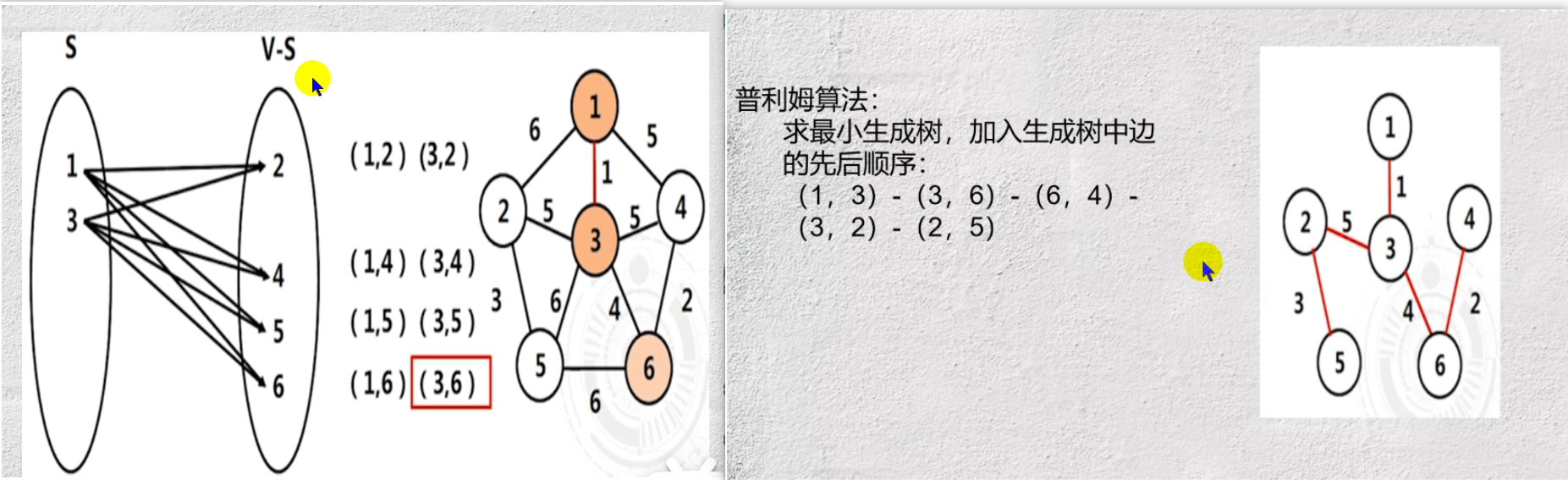
最小生成树 普里姆(prim)算法 (从顶点 考虑)
选择初始点 把图中的顶点分成两个不同的顶点集S(生成树的顶点集),V-S
在横跨两个不同顶点集的边中选择一条权值最小的边加入到生成树中
将该边的另一个顶点加入到顶点集S中,并从V-S中删除
重复步骤2,3,知道V-S为空集
1 2 3 4 5 6 7 8 9 10 11 12 13 14 15 16 17 18 19 20 21 22 23 24 25 26 27 28 29 30 public static Set<Edge> primMST (Graph graph) { PriorityQueue<Edge> priorityQueue = new PriorityQueue <>(new Comparator <Edge>() { @Override public int compare (Edge o1, Edge o2) { return o1.weight - o2.weight; } }); HashSet<Node> set = new HashSet <>(); HashSet<Edge> result = new HashSet <>(); for (Node node : graph.nodes.values()) { if (!set.contains(node)) { set.add(node); priorityQueue.addAll(node.edges); while (!priorityQueue.isEmpty()) { Edge edge = priorityQueue.poll(); Node toNode = edge.to; if (!set.contains(toNode)) { set.add(toNode); result.add(edge); priorityQueue.addAll(toNode.edges); } } } } return result; }
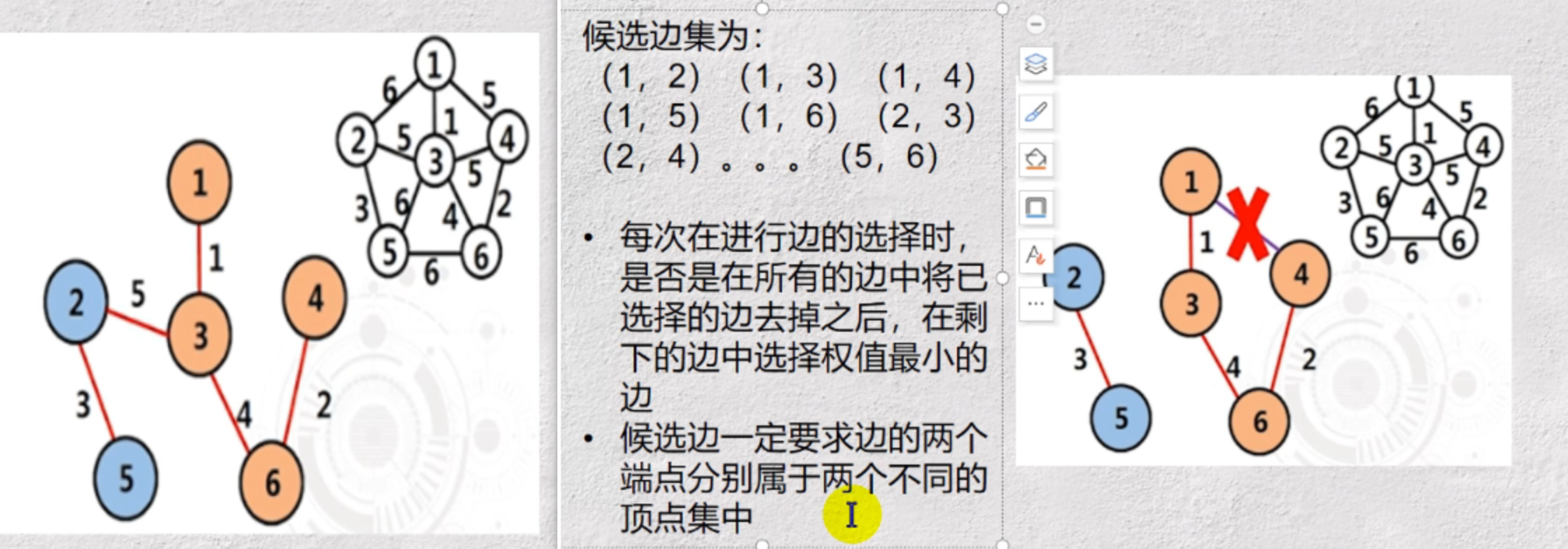
克鲁斯卡尔(kruskal)算法 (从边 考虑)
把图中的顶点看成n个不同的顶点集,每个顶点集都只含1个顶点
每次都在横跨不同顶点集的边 中选择一条权值最小的边加入到最小生成树中
直到图中所有的顶点都在同一个顶点集为止
1 2 3 4 5 6 7 8 9 10 11 12 13 14 15 16 17 18 19 20 21 22 23 24 25 26 27 28 29 30 31 32 33 34 35 36 37 38 39 40 41 42 43 44 45 46 47 48 49 50 51 52 53 54 55 56 57 58 59 60 61 62 63 64 65 66 67 68 69 70 71 72 73 74 75 76 77 78 79 80 81 82 83 84 85 86 87 public class Kruskal { public static Set<Edge> kruskalMST (Graph graph) { UnionFind unionFind = new UnionFind (); unionFind.makeSets(graph.nodes.values()); PriorityQueue<Edge> priorityQueue = new PriorityQueue <>(new Comparator <Edge>() { public int compare (Edge o1, Edge o2) { return o1.weight - o2.weight; } }); for (Edge edge : graph.edges) { priorityQueue.add(edge); } Set<Edge> result = new HashSet <>(); while (!priorityQueue.isEmpty()) { Edge edge = priorityQueue.poll(); if (!unionFind.isSameSet(edge.from, edge.to)) { result.add(edge); unionFind.union(edge.from, edge.to); } } return result; } public static class UnionFind { private HashMap<Node, Node> fatherMap; private HashMap<Node, Integer> sizeMap; public UnionFind () { fatherMap = new HashMap <Node, Node>(); sizeMap = new HashMap <Node, Integer>(); } public void makeSets (Collection<Node> nodes) { fatherMap.clear(); sizeMap.clear(); for (Node node : nodes) { fatherMap.put(node, node); sizeMap.put(node, 1 ); } } private Node findFather (Node n) { Stack<Node> path = new Stack <>(); while (n != fatherMap.get(n)) { path.add(n); n = fatherMap.get(n); } while (!path.isEmpty()) { fatherMap.put(path.pop(), n); } return n; } public boolean isSameSet (Node a, Node b) { return findFather(a) == findFather(b); } public void union (Node a, Node b) { if (a == null || b == null ) { return ; } Node aDai = findFather(a); Node bDai = findFather(b); if (aDai != bDai) { int aSetSize = sizeMap.get(aDai); int bSetSize = sizeMap.get(bDai); if (aSetSize <= bSetSize) { fatherMap.put(aDai, bDai); sizeMap.put(bDai, aSetSize + bSetSize); sizeMap.remove(aDai); } else { fatherMap.put(bDai, aDai); sizeMap.put(aDai, aSetSize + bSetSize); sizeMap.remove(bDai); } } } } }
堆 比较器 1 2 3 4 5 6 new Comparator <T>() { @Override public int compare (T o1, T o2) { return o1.xx - o2.xx; } });
一般会这样规定:
升序:前减后,即 o1 - o2
降序:后减前,即 o2 - o1
或者:
返回负数时,o1排在前;
返回正数时,o2排在前;
返回0时,二者相等;
动态规划 尝试模式(暴力递归) 暴力递归-从左往右的尝试
尝试就是接解题的步骤,也可以说尝试就是暴力递归。
从左往右,就是坐标逐步往后移动,解决问题。
字符串的全部子序列 打印一个字符串的全部子序列
1 2 3 4 5 6 7 8 9 10 11 public static void process1 (char [] str, int index, List<String> ans, String path) { if (index == str.length) { ans.add(path); return ; } String no = path; process1(str, index + 1 , ans, no); String yes = path + String.valueOf(str[index]); process1(str, index + 1 , ans, yes); }
字符串的全排列 打印一个字符串的全排列。
1 2 3 4 5 6 7 8 9 10 11 public static void process2 (char [] str, int i, ArrayList<String> res) { if (i == str.length) { res.add(String.valueOf(str)); } for (int j = i; j < str.length; j++) { swap(str, i, j); process2(str, i+1 ,res); swap(str, i, j); } }
打印一个字符串的全排列,要求不要出现重复的排列
1 2 3 4 5 6 7 8 9 10 11 12 13 14 15 public static void process3 (char [] str, int i, ArrayList<String> res) { if (i == str.length) { res.add(String.valueOf(str)); } boolean [] visit = new boolean [26 ]; for (int j = i; j < str.length; j++) { if (!visit[str[i] - 'a' ]) { visit[str[i] - 'a' ] = true ; swap(str, i, j); process2(str, i+1 ,res); swap(str, i, j); } } }
数字转化字母 (facebook面试题)
规定1和A对应、2和B对应、3和C对应……那么一个数字字符串比如”111”就可以转化为: “AAA”、”KA”和”AK”;
1 2 3 4 5 6 7 8 9 10 11 12 13 14 15 16 17 18 19 20 21 22 23 24 25 26 27 28 public static int process4 (char [] str, int i) { if (i == str.length) { return 1 ; } if (str[i] == '0' ) { return 0 ; } if (str[i] == '1' ) { int res = process4(str, i + 1 ); if (i + 1 < str.length) { res += process4(str, i + 2 ); } return res; } if (str[i] == '2' ) { int res = process4(str, i + 1 ); if (i + 1 < str.length && (str[i+1 ] >= '0' && str[i+1 ] <= '6' )) { res += process4(str, i + 2 ); } return res; } return process4(str, i + 1 ); }
拿纸牌 给定一个整型数组ar,代表数值不同的纸牌排成一条线,玩家A和玩家B依次拿走每张纸牌,规定玩家A先拿,玩家B后拿,但是每个玩家每次只能拿走最左或最右的纸牌,玩家A和玩家B都绝顶聪明。
请返回最后获胜者的分数。
1 2 3 4 5 6 7 8 9 10 11 12 13 14 15 16 17 18 19 20 21 22 public static int win1 (int [] arr) { if (arr== null || arr.length == 0 ) { return 0 ; } return Math.max(f(arr, 0 , arr.length-1 ), s(arr, 0 , arr.length - 1 )); } public static int f (int [] arr, int l, int r) { if (l == r) { return arr[l]; } return Math.max(arr[l] + s(arr, l+1 , r), arr[r] + s(arr, l, r-1 )); } public static int s (int [] arr, int i, int j) { if (i == j) { return 0 ; } return Math.min(f(arr, i+1 , j), f(arr, i, j-1 )); }
n皇后 N皇后问题是指在N*N的棋盘上要摆N个皇后,要求任何两个皇后不同行、不同列,也不在同一条斜线上。
给定一个整数n,返回n皇后的摆法有多少种。
1 2 3 4 5 6 7 8 9 10 11 12 13 14 15 16 17 18 19 20 21 22 23 24 25 26 public static int nQueen (int i, int [] record, int n) { if (i == n) { return 1 ; } int res = 0 ; for (int j = 0 ; j < n; j++) { if (isValid(record,i, j)) { record[i] = j; res += nQueen(i+1 , record, n); } } return res; } public static boolean isValid (int [] record, int i, int j) { for (int k = 0 ; k < i; k++) { if (j == record[k] || Math.abs(record[k] - j) == Math.abs(i - k)) { return false ; } } return true ; }
n皇后的位运算优化,优化常数操作
1 2 3 4 5 6 7 8 9 10 11 12 13 14 15 16 17 18 19 20 21 22 23 24 25 26 27 28 29 30 31 32 33 34 35 36 37 38 39 40 41 42 43 44 45 46 47 48 49 50 51 52 53 54 55 56 public static int nQueen2 (int n) { if (n < 1 || n > 32 ) { return 0 ; } int limit = n == 32 ? -1 : (1 << n) - 1 ; return nq2(limit, 0 , 0 , 0 ); } public static int nq2 ( int limit, int colLim, int leftDiaLim, int rightDiaLim) { if (colLim == limit) { return 1 ; } int pos = limit & (~(colLim | leftDiaLim | rightDiaLim)); int mostRightOne = 0 ; int res = 0 ; while (pos != 0 ) { mostRightOne = pos & (~pos + 1 ); pos = pos - mostRightOne; res += nq2(limit, colLim | mostRightOne, (leftDiaLim | mostRightOne) << 1 , (rightDiaLim | mostRightOne) >>> 1 ); } return res; } public static void main (String[] args) { int n = 13 ; int [] record1 = new int [n]; long start = System.currentTimeMillis(); System.out.println(nQueen(0 , record1, n)); long end = System.currentTimeMillis(); System.out.println("cost time: " + (end -start) + "ms" ); int [] record2 = new int [n]; long start2 = System.currentTimeMillis(); System.out.println(nQueen2(n)); long end2 = System.currentTimeMillis(); System.out.println("cost time: " + (end2 -start2) + "ms" ); }
范围上的尝试 多样本位置全对应的尝试 寻找业务限制的尝试 动态规划 例1:
假设有排成一行的N个位置,记为1 ~ N, N一定大于或等于2;
开始时机器人在其中的M位置上(M一定是1 ~ N中的一个);机器人可以在 1 ~ N 范围内行动;规定机器人必须走K步,最终能来到P位置(P也是1~N中的一个) 的方法有多少种? 给定四个参数N、M、K、P, 返回方法数。
JAVA方法 Math.random Math.random会等概率 地返回Double类型的 [0, 1) 的随机数,应用:
随机返回 [0, k) 的数: Math.random() * k
随机返回 [0, k] 的整数: (int) Math.random() * (k+1)
设x属于 [0, 1) ,原本 x 在[0, x) 上出现的概率是 x,如果要将出现的概率改为 x^2^ :
1 Math.max(Math.random(), Math.random())
1-5随机到1-7随机 例1:设有一个方法f1(),它等概率返回 [1,5],现要求将其改成等概率返回 [1,7] 的方法:
思路:先将f1改成 01等概率方法f2,则f2可以表示一位二进制位,已知三个二进制位可表示 [0,7],所以利用位运算可以得到一个等概率的3位二进制数,再将等于0的机会均分给其他的数即可。
改造成01等概率,有奇数个则将某个数的概率均分给其他数,有偶数个直接平分即可。
1 2 3 4 5 6 7 8 9 10 11 12 13 14 15 16 17 18 19 20 21 22 23 24 25 public static int f1 () { return (int ) (Math.random() * 5 ) + 1 ; } public static int f2 () { int ans; do { ans = f1(); } while (ans == 3 ); return ans < 3 ? 0 : 1 ; } public static int f3 () { int ans; do { ans = (f2() << 2 ) + (f2() << 1 ) + f2(); } while (ans == 0 ); return ans; }
01不等概率到01等概率 例2:设方法f1()返回0的概率是p,返回1的概率是1- p,只使用f1(),写出能等概率返回01的方法。
思路:调用俩次f1,组成一个二位的二进制数,则01和10的概率均为 p(1- p),而00概率p^2^,11概率(1- p)^2^。所以取01和10作为 0和1返回,00和11直接舍去。
1 2 3 4 5 6 7 8 9 10 11 12 13 public static int f1 () { return Math.random() > 0.7 ? 1 : 0 ; } public static int f2 () { int ans; do { ans = f1(); }while (ans == f1()); return ans; }
对数器 对数器:有一个能随机生成符合要求的数组的方法,一个用于复制的方法,一个验证正误的方法;
在比赛中,一般只会给出一两道简单的例子,不能验证算法是否正确,所以就可以用对数器进行大量例子验证。
1 2 3 4 5 6 7 8 9 10 11 12 13 14 15 16 17 18 19 20 21 22 23 24 25 26 27 28 29 30 31 32 33 34 35 36 37 38 39 40 41 42 43 44 45 46 47 48 49 public static int [] lenAndValueRandom(int maxLen, int maxValue) { int len = (int ) (Math.random() + maxLen); int [] ans = new int [len]; for (int i = 0 ; i < len; i++) { ans[i] = (int ) (Math.random() * maxValue); } return ans; } public static int [] copy(int [] arr) { int [] ans = new int [arr.length]; for (int i = 0 ; i < arr.length; i++) { ans[i] = arr[i]; } return ans; } public static boolean judge (int [] arr) { return true ; } public static void algorithm1 (int [] arr) { } public static void main (String[] args) { int maxLen = 5 ; int maxValue = 1000 ; int testTime = 10000 ; for (int i = 0 ; i < testTime; i++) { int [] arr1 = lenAndValueRandom(maxLen, maxValue); int [] arr2 = copy(arr1); if (!judge(arr1)){ System.out.println("算法出错了" ); for (int k : arr2) { System.out.print(k + " " ); } for (int k : arr1) { System.out.print(k + " " ); } } } }
动态数组 动态数组每次容量不够时,ArrayList会扩容至1.5倍,而Vector容量会扩至2倍,并将旧数据拷贝进去;不管是ArrayList还是Vector,多次扩容的时间代价是一个等比数列,所以扩容的时间复杂度是O(N),当每一步扩容均摊到算法计算过程中,可以当作常数操作,所以使用动态数组不影响时间复杂度。